Shared Medical Appointments (SMA)
A proven yet underutilized clinical model that's transforming chronic disease care.
Shared Medical Appointments: Basics

There Is No Universal Definition of SMA
SMA have been implemented around the world for decades in a variety of ways to meet the unique needs of different patients, providers, health systems, and clinical conditions. General best practices are well-established, however there is currently no singular definition of what an SMA is or how one should be run. SMA are intentionally flexible, designed to meet the unique needs of different patients, providers, health systems, and clinical conditions. There is no one-size-fits-all model, which is part of what makes them so adaptable and scalable.
SMA Basics:
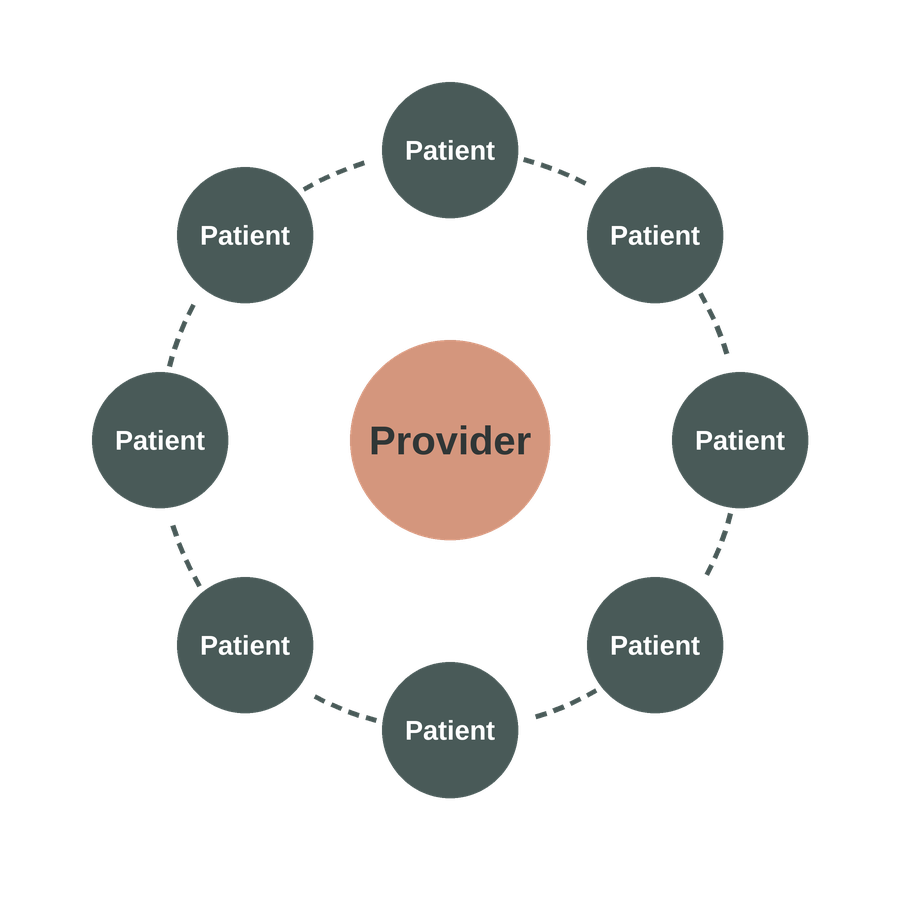
An ambulatory care delivery strategy in which multiple patients participate in a group session that integrates patient education and empowerment with individualized medical care by a clinician (MD, DO, NP, or PA) who documents and bills for multiple individual visits.
Working Definition
Number of Patients
Typically 5-15 patients
Duration
Typically 60-120 minutes
Every SMA has two core components that work together: (1) high-yield education (see Content) or a shared experience (e.g., meditation or cooking) in a group setting, plus (2) individualized patient check-ins that generate diagnostic and treatment care plans, which are documented and billed as follow-up visits (see SMA Implementation Guide).
Structure
Team Members
There must be a billing provider (MD, DO, NP, or PA) conducting individualized check-ins with each patient during an SMA. Additional team members (e.g., health and wellness coach, dietitian, or pharmacist) can enhance the session.
Location
In person or virtual
Number of Sessions
SMA can be run as single sessions or as multi-part series. Most research focuses on series targeting chronic disease management.
Patient Cost
Because each patient is billed for a follow-up visit, standard co-payments and deductibles apply. For many patients, particularly those attending virtual SMA, this may mean little to no out-of-pocket cost.
Financials
Because each patient is billed individually for a follow-up visit, SMA can generate significantly more revenue per hour than standard 1-on-1 care, supporting program growth and sustainability (see SMA Financials).
National Support for SMA
SMA aren't fringe — they're endorsed by the nation's leading medical organizations.
“H-160.882: 1. Our American Medical Association recognizes Shared Medical Appointments and/or Group Medical Visits, as an effective model of care delivery, 2. Our AMA advocates to hospitals and health systems that they support physicians and other clinicians who desire to host Shared Medical Appointments and/or Group Medical Visits., 3. Our AMA advocates for payment of in-person or telehealth Shared Medical Appointments and/or Group Medical Visits, utilizing CPT codes and AMA-CPT coding guidance.” - American Medical Association

“The [Massachusetts Medical Society (MMS)] recognizes shared medical appointments, also known as group visits, as an effective model of care delivery. (HP) The MMS supports payment for shared medical appointments, also known as group visits, commensurate with time spent in delivery of care, or complexity of medical decision-making using standard billing codes, with individual assessments occurring within the group setting. (HP) MMS House of Delegates, 5/17/25” - Massachusetts Medical Society
“Studies have shown that groups visits are cost effective and efficient, contributing to increased self-management, improved health outcomes, decreased emergency department use and specialty visits, and increased patient and provider satisfaction.” - National Association of Community Health Centers

“The American Academy of Family Physicians (AAFP) believes group visits are a proven, effective method for enhancing a patient’s self-care, increasing patient satisfaction, and improving outcomes.” - American Academy of Family Physicians

“Shared medical appointments (SMAs) combine medical care, peer support, and skills-based learning to improve OUD treatment outcomes” - American Society of Addiction Medicine
“Lifestyle Medicine Shared Medical Appointments (LMSMAs) are a model of health care delivery that can address the challenges posed by chronic disease by improving access to care, reducing cost to patients and hospitals, reducing provider burnout and improving clinical outcomes.” - American College of Lifestyle Medicine
SMA Voices From Research Participants
Here's what patients and providers say about their SMA experience, drawn directly from published research articles.

“… After hearing other people be open and honest, I think it gives me—or just allows you to be more honest yourself because you’ve already heard other people expose themselves or be honest.”
— SMA Patient (Graham et al., 2021)
“I think you gain a feeling of security, of understanding, of sharing with other people, of compassion, of support... so many things that you wouldn’t gain if you were one on one because of the humanity of us as people. You know we try to support one another.”
— SMA Patient (Lavoie et al., 2013)

“…You come out of the group feeling much more self-confident and willing to challenge your self-management program, you just feel that your batteries are recharged…you want to do more yourself and rely less on others.”
— SMA Patient (Lavoie et al., 2013)

“I think there’s no question about the overall goodness of what we’re doing… when you take in patient satisfaction, your satisfaction, and meeting objectives for chronic disease management… this is a far superior way to go.”
— SMA Provider (Wong et al., 2015)
“[SMAs] kind of a win all around because when you increase your productivity you increase access for patients, your waiting times go down…we’re better able to meet evidence-based guidelines because there’s a team taking care of patients rather than a single provider.”
— SMA Provider (Graham et al., 2021)
Shared Medical Appointments In Action
Leading health systems across the country are already running successful SMA programs. Here are a few examples.
-
![View of Boston skyline with tall skyscrapers, a body of water in the foreground, and a small sailboat on the water.]()
Massachusetts General Hospital Healthy Lifestyle Program
-
![Skyline of Cleveland, Ohio with skyscrapers reflecting the late afternoon sunlight and a body of water in the foreground under cloudy skies.]()
Cleveland Clinic Shared Medical Appointments
-
![Aerial view of a city skyline with tall modern skyscrapers.]()
Saint Francis Lifestyle Medicine
-
![Aerial view of New York City skyline at sunrise, featuring the Empire State Building, skyscrapers, and the Hudson River in the distance.]()
NYC Health+Hospital Lifestyle Medicine
-
![Looking up from the ground at the domed ceiling of a grand interior space, revealing an ornate, circular ceiling with intricate gold and white detailing, surrounded by columns and decorative arches.]()
University of Mississippi Medical Center
-
![City skyline with tall modern buildings and bridge over a river, under a clear blue sky with scattered clouds.]()
Corewell Health Lifestyle Medicine
-
![Colorful historic Victorian houses, known as the Painted Ladies, with the modern San Francisco skyline in the background during sunset.]()
UCSF Osher Center for Integrative Health
-
![City skyline at dusk with buildings, water in the foreground, and a clear sky.]()
UToledo Health
-
![A cityscape featuring the Old Courthouse with a green dome, the Gateway Arch in the background, surrounded by modern high-rise buildings and streets with cars.]()
WashU Living Well Center
-
![Aerial view of a city skyline with a water body in the foreground, featuring several boats, including sailboats and a yacht, and modern high-rise buildings.]()
UC San Diego Health
-
![Night view of the San Francisco skyline with bridges illuminated, reflecting in the water, and city lights across the bay.]()
Sutter Health
-
![A panoramic view of a city skyline under a partly cloudy sky, with tall skyscrapers, highways, and residential areas in the foreground.]()
Parkland Health












Shared Medical Appointment Videos
Hear directly from practitioners and patients.
Shared Medical Appointments In The News
Shared Medical Appointments are gaining national attention. Here's what the press is saying.
-
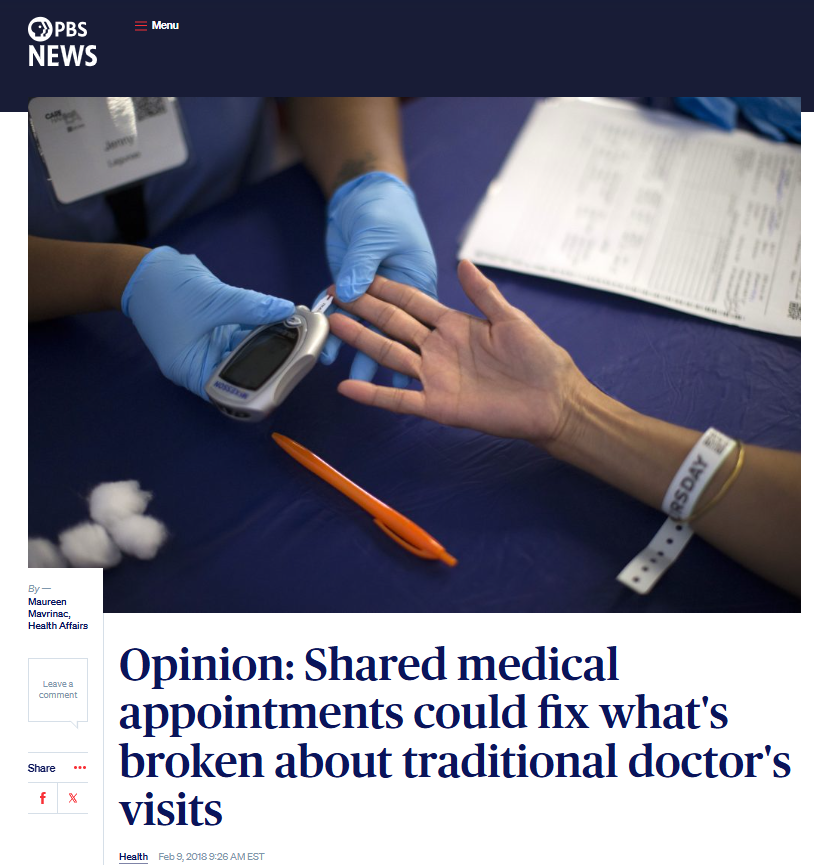
![A healthcare professional wearing blue gloves is using a pulse oximeter on a patient's finger. The patient has an identification bracelet and is lying on a table with hospital papers nearby.]()
Opinion: Shared medical appointments could fix what's broken about traditional doctor's visits
-
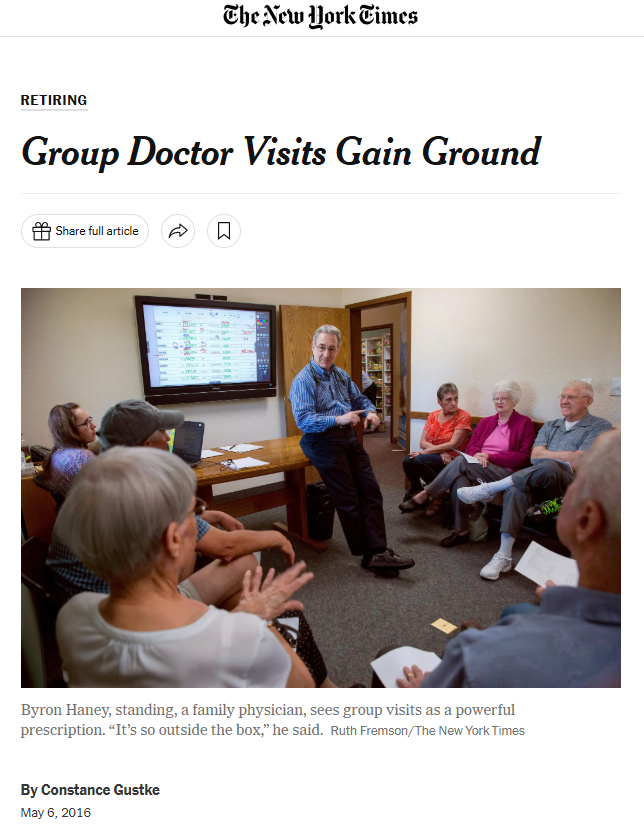
![A group of elderly people seated in a small room, listening to a man standing near a television screen, which displays a colorful chart or presentation. The man appears to be explaining something to the group.]()
Group Doctor Visits Gain Ground
-
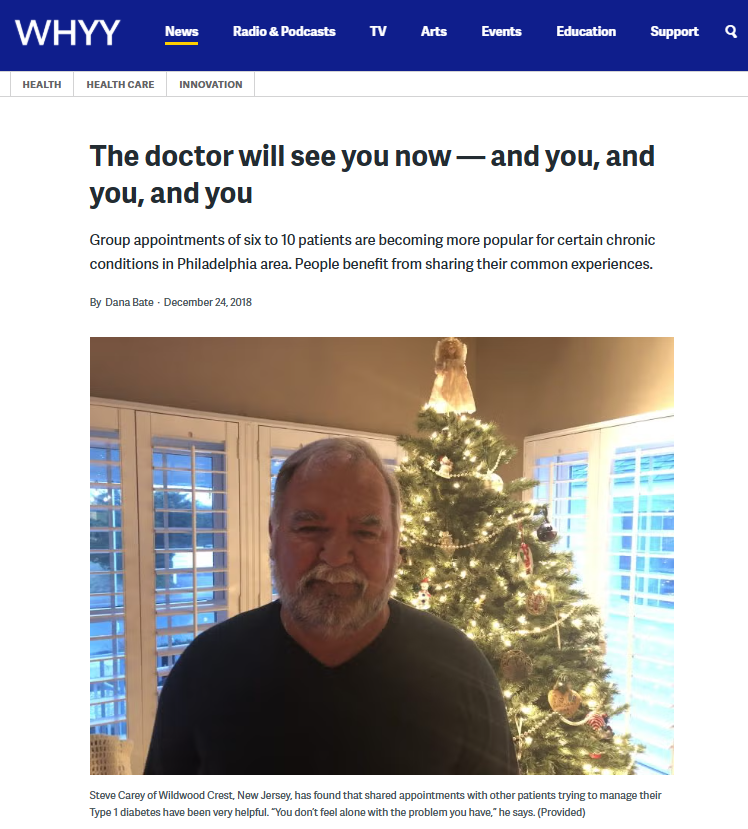
![A man with a beard and mustache poses in front of a decorated Christmas tree with lights. He appears to be indoors, near windows with white shutters.]()
The doctor will see you now — and you, and you, and you
-
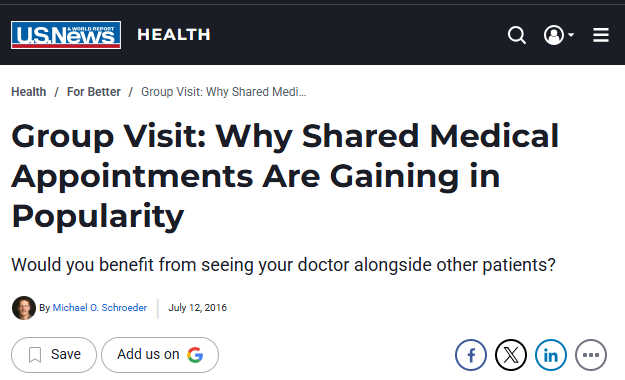
![Screenshot of a U.S. News health article titled 'Group Visit: Why Shared Medical Appointments Are Gaining in Popularity,' authored by Michael O. Schroeder, published on July 12, 2016.]()
Group Visits: Why Shared Medical Appointments Are Gaining Popularity
-
![A healthcare professional in a white coat with a stethoscope holding a digital graphic of a hospital building, overlaid with medical icons and digital interface graphics.]()
The shared medical appointment: Building the case for a major shift in primary healthcare
-
![Six orange chairs arranged in a circle on a dark wooden floor.]()
Need to See the Doctor? You May Have Company on Your Next Visit